Technology
185.63.253.300 Safety Check: Risks, Errors, and Technical Explanation

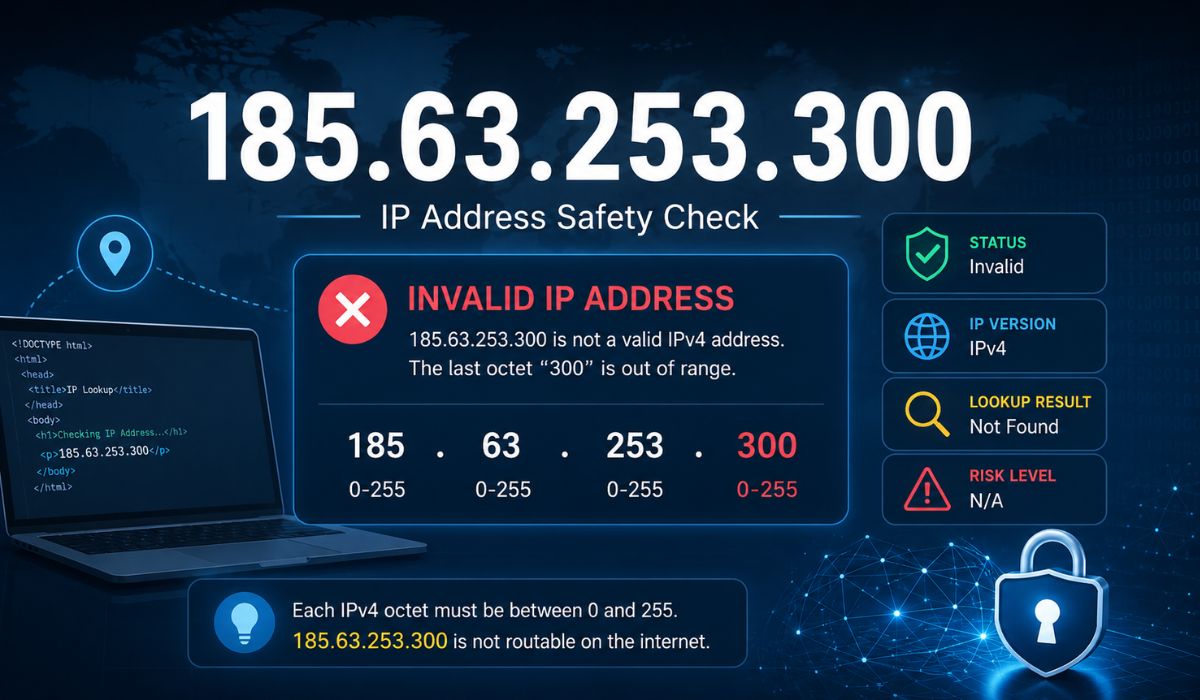
The term 185.63.253.300 may look like a normal IP address at first glance, but it contains one major technical problem: the last number, 300, is outside the valid IPv4 range. In standard IPv4 formatting, an address is written as four number blocks separated by dots, and each block must be between 0 and 255. That means 185.63.253.300 is not a valid working IP address, even though it may appear in search results, server logs, browser errors, suspicious links, or technical discussions. For everyday internet users, website owners, cybersecurity beginners, and small business teams, understanding this detail matters because invalid IP strings can cause confusion during troubleshooting, security checks, DNS lookups, and network monitoring.
What Is 185.63.253.300?
185.63.253.300 is best understood as an invalid IPv4-style entry, not a usable internet address. The first three sections, 185, 63, and 253, appear technically possible, but the final section breaks the rule because 300 is too high. This small formatting issue changes everything. A valid IP address can point to a device, server, router, hosting provider, or network resource, but an invalid IP address cannot be routed on the public internet in the normal way. So, if someone searches for 185.63.253.300, they are likely trying to understand whether it is dangerous, whether it belongs to a website, or why it appears in a system record.
Why 185.63.253.300 Is Not a Valid IPv4 Address
To understand the issue clearly, think of an IPv4 address as four digital boxes. Each box can only hold a value from 0 to 255 because IPv4 is based on 8-bit sections called octets. Since 300 is greater than 255, 185.63.253.300 fails basic IP address validation. This does not mean the address is automatically malware or a hacker’s tool, but it does mean it should not be treated as a real destination. If a lookup tool, firewall, browser, or website scanner rejects it, that rejection is expected. The problem is not necessarily with the tool; the problem is with the format of the address itself.
Common Reasons This Address Appears Online
There are several common reasons why a string like 185.63.253.300 may appear online. It may be a typo where someone meant to type a nearby valid address, such as one ending in a number between 0 and 255. It may also be generated by poor data entry, broken scripts, fake examples, copied log fragments, or automated spam content. In some cases, invalid IP-style strings are used in low-quality pages to attract search traffic from people checking suspicious addresses. For website owners, the safest approach is to treat 185.63.253.300 as a malformed IP entry and verify the original source before taking action.
Is 185.63.253.300 Dangerous?
The address 185.63.253.300 is not dangerous in the same way a confirmed malicious server might be dangerous, because it is not a valid routable IPv4 address. However, the context around it can still be risky. If it appears inside a suspicious email, fake security warning, unknown download page, phishing message, or strange redirect, the risk comes from the source that used the string, not from the invalid IP itself. Cybercriminals sometimes use technical-looking numbers to make scams appear more believable. Users should avoid clicking links, downloading files, or entering passwords on pages that use confusing technical claims without clear proof.
How to Perform a Safety Check
A practical safety check starts with validation. First, confirm whether the IP address format is valid. Since 185.63.253.300 fails that test, there is no need to perform a normal IP reputation lookup on the exact string. Next, review where you found it. Was it in a server log, email header, website popup, analytics report, firewall alert, or browser message? Then check for nearby valid addresses, related domains, timestamps, and user activity. If the string appears with suspicious behavior, such as failed login attempts, strange referrers, malware warnings, or repeated bot traffic, investigate the full event rather than focusing only on the invalid address.
185.63.253.300 in Server Logs and Security Tools
For site owners and administrators, seeing 185.63.253.300 in logs can be confusing because logs are often expected to contain real client IP addresses. If an invalid IP appears, it may indicate a parsing issue, corrupted data, custom header manipulation, or a badly formatted entry from a third-party tool. Attackers and bots may also send fake headers such as X-Forwarded-For values to confuse logging systems. A secure setup should not blindly trust user-supplied headers. Instead, logs should be filtered, validated, and compared against trusted proxy settings so false IP data does not mislead security decisions.
Difference Between Invalid IPs and Malicious IPs
An invalid IP address and a malicious IP address are not the same thing. A malicious IP is a valid address that has been linked to harmful activity, such as spam, brute-force attacks, malware hosting, botnet traffic, credential stuffing, or phishing infrastructure. An invalid IP, like 185.63.253.300, simply does not meet the technical format rules. It cannot be accurately judged through normal IP reputation systems because it is not a legitimate address. This distinction helps prevent false alarms. Instead of labeling the string itself as malicious, users should examine the page, email, software, or log event where it appeared.
Why IP Address Validation Matters
IP address validation is important because many security systems depend on clean and accurate network data. Firewalls, access controls, analytics platforms, fraud detection systems, VPN tools, and hosting dashboards all rely on properly formatted addresses. If invalid entries are allowed into reports, they can create confusion, waste investigation time, and hide the real source of suspicious traffic. For developers, validation should happen before storing or processing IP data. For content creators writing about 185.63.253.300, the most helpful explanation is not to exaggerate the danger but to explain why the address is technically impossible as a standard IPv4 address.
What Users Should Do If They See It
If you see 185.63.253.300 on a website, in an email, or in a security alert, stay calm and avoid quick assumptions. Do not enter personal details into any page simply because it displays technical language. Do not download tools claiming to “fix” the address unless they come from a trusted security provider. If the string appears in your own website logs, check whether your logging tool is reading headers correctly. If it appears in a suspicious message, delete the message or report it as phishing. If it appears in a business system, ask your IT team to review the surrounding activity.
Best Practices for Website Owners and Developers
Website owners should use strong input validation, reliable logging, and secure header handling to prevent invalid IP strings from polluting data. Developers can use trusted libraries to validate IP addresses instead of building weak manual checks. Security teams should also separate invalid entries from confirmed threat intelligence. This keeps reports clean and helps teams focus on real risks. If your site receives repeated malformed IP entries, review bot protection, web application firewall settings, reverse proxy configuration, and server access logs. The goal is not only to block bad traffic but also to understand whether the data is real, spoofed, or misread.
Final Thoughts
The most important fact about 185.63.253.300 is simple: it is not a valid IPv4 address because 300 is outside the accepted 0–255 range. That makes it a technical error, malformed entry, or suspicious-looking string rather than a normal internet address. Still, users should pay attention to where it appears. If it shows up in spam, phishing content, fake alerts, or strange server logs, the surrounding context may deserve investigation. A smart safety check focuses on validation, source review, log accuracy, and cautious online behavior. In short, 185.63.253.300 is not a valid IP, but it can still be a useful clue when reviewing technical errors or suspicious activity.
Frequently Asked Questions (FAQs)
1. Is 185.63.253.300 a real IP address?
No, 185.63.253.300 is not a real valid IPv4 address. The final number, 300, is too high because each IPv4 section must be between 0 and 255.
2. Why does 185.63.253.300 appear in search results?
It may appear because people search for suspicious IP-style strings, technical errors, server log entries, or fake addresses. Some pages may also use unusual IP terms to attract technology-related search traffic.
3. Can 185.63.253.300 be used to track someone?
No, this exact string cannot be used as a normal tracking IP because it is invalid. To investigate real traffic, you need a valid IP address, domain name, timestamp, and trusted log source.
4. Is 185.63.253.300 linked to malware?
The string itself is not a valid IP, so it cannot be confirmed as a malware-hosting address. However, if it appears inside a suspicious email, popup, or download page, the surrounding content should be treated carefully.
5. What makes an IPv4 address valid?
A valid IPv4 address has four numbers separated by dots. Each number must range from 0 to 255, such as 192.168.1.1 or 8.8.8.8.
6. Should I block 185.63.253.300 in my firewall?
Blocking the exact address is usually unnecessary because it is not valid. Instead, review your firewall logs and check whether a real nearby IP address or suspicious domain is involved.
7. Could 185.63.253.300 be a typo?
Yes, it could easily be a typo. Someone may have entered the wrong final number or copied an address incorrectly from a log, report, or website.
8. What should I do if this address appears in my website logs?
Check your logging setup, proxy headers, and security tools. If the entry appears repeatedly, investigate the full request details, including user agent, referrer, timestamp, and any related valid IP addresses.
For You: What Is Voozon? Complete Guide to This Digital Content Platform


William Givens Jensen Biography: Family, Career, and Connection to Robin Givens

Who Is Noelle Inguagiato? Everything to Know About Jesse Watters’ Ex-Wife

Mallory Plotnik: Her Life, Family, and Marriage to Phil Wickham

MobilesRus Services: Devices, Accessories, Repairs, and More

Calamariere Explained: Complete Guide to Taste, Cooking, and Serving Ideas

AgentCarrot ATX Bogus Review: Meaning, Risks, and Online Truth

Severna Dakota Lifestyle Trends: Nature, Small Towns, and Local Charm

185.63.253.300 Safety Check: Risks, Errors, and Technical Explanation

What Is Voozon? Complete Guide to This Digital Content Platform

Health Threetrees Com VN Explained for Beginners Seeking Better Health
William Givens Jensen Biography: Family, Career, and Connection to Robin Givens
Who Is Noelle Inguagiato? Everything to Know About Jesse Watters’ Ex-Wife
Mallory Plotnik: Her Life, Family, and Marriage to Phil Wickham
MobilesRus Services: Devices, Accessories, Repairs, and More
Calamariere Explained: Complete Guide to Taste, Cooking, and Serving Ideas
AgentCarrot ATX Bogus Review: Meaning, Risks, and Online Truth
Severna Dakota Lifestyle Trends: Nature, Small Towns, and Local Charm
185.63.253.300 Safety Check: Risks, Errors, and Technical Explanation
What Is Voozon? Complete Guide to This Digital Content Platform
Health Threetrees Com VN Explained for Beginners Seeking Better Health
-

 Celebrity4 months ago
The Untold Story of Jessica Isabel Rowling Arantes and Her Famous Mother J. K. Rowling
-

 Celebrity4 months ago
Who Is Natalie Oglesby Skalla? The Untold Story of Frank Sinatra Jr.’s Daughter
-
 Health4 months ago
Health Threetrees Com VN Explained for Beginners Seeking Better Health
-

 Celebrity4 months ago
Grace Anne Matthews’ Story: Growing Up as Dave Matthews’ Daughter